Eclipse: the spectacular mechanics of a celestial alignment
On August 12, 2026, Earth and the Moon align to produce a total solar eclipse over northern Spain, something the peninsula hasn't experienced in over a century. We visualize the orbital geometry, lunar nodes and the shadow's path that make it possible.
A total solar eclipse over northern Spain -- something the peninsula hasn't seen in over a century -- is the result of a very precise alignment between the Sun, the Moon and Earth. It isn't magic or coincidence: it's orbital geometry that astronomers can calculate centuries in advance.
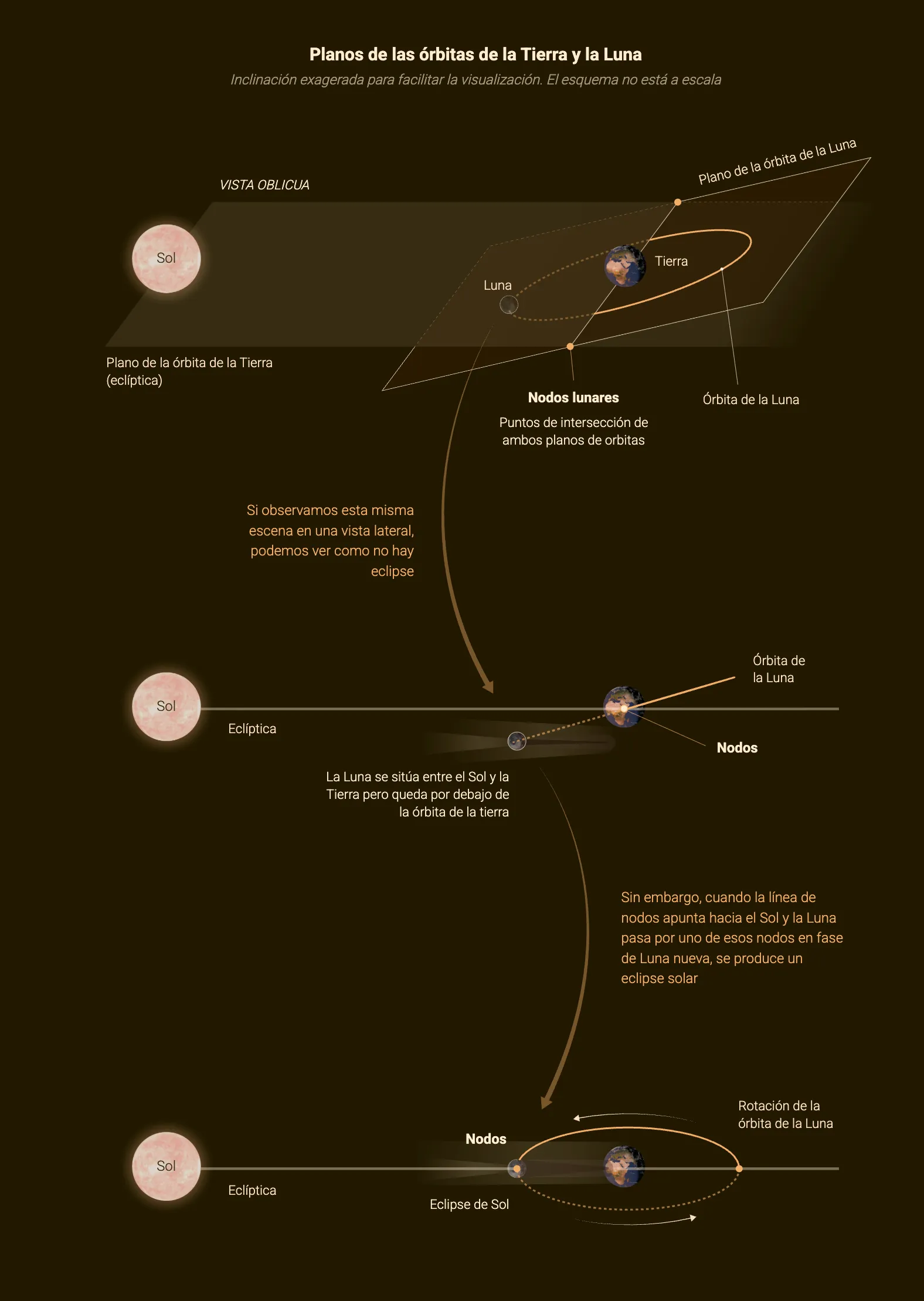
nodos lunares y sombra proyectada -- que explica por qué los eclipses son un fenómeno raro y no algo que ocurre cada luna nueva.
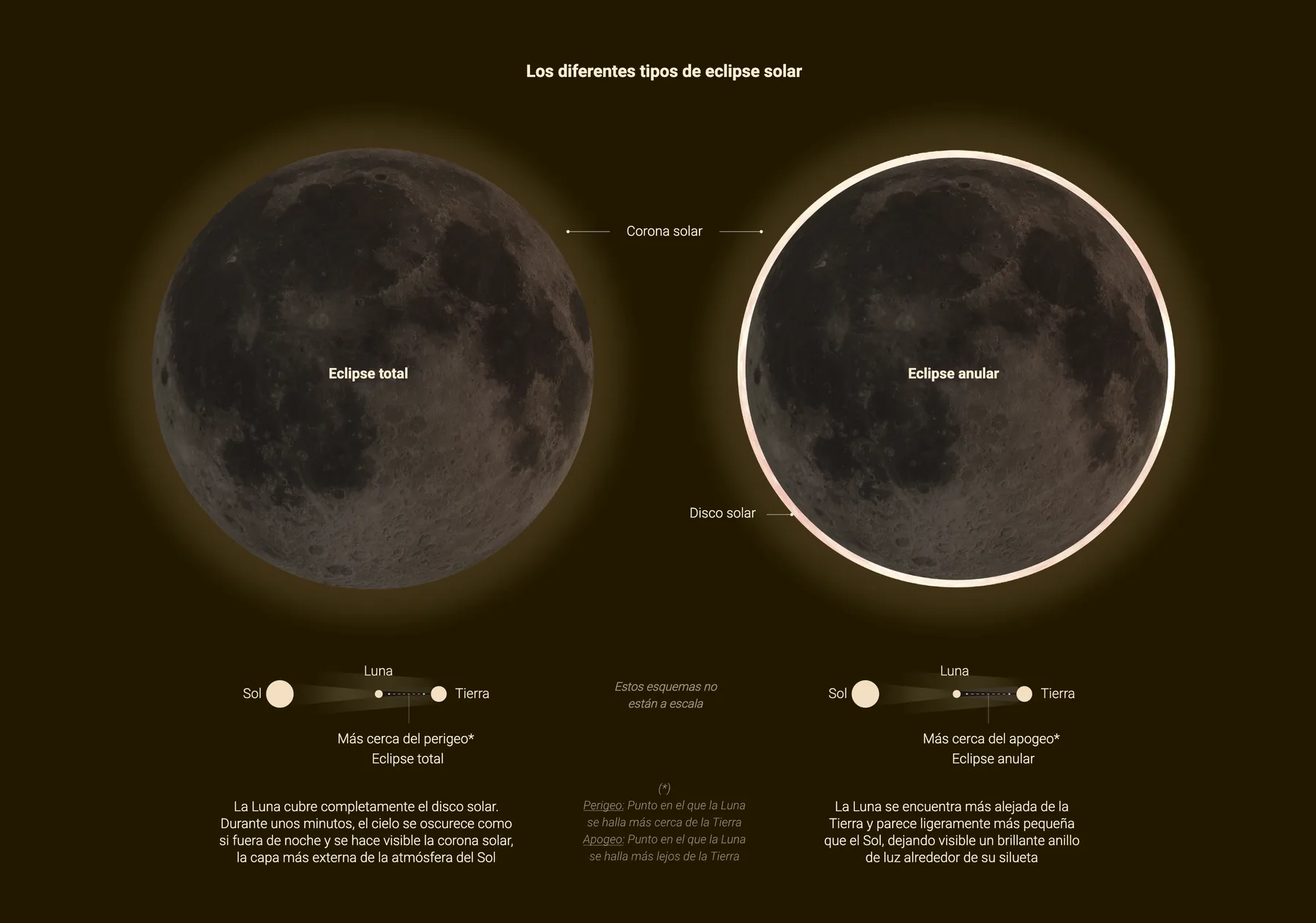
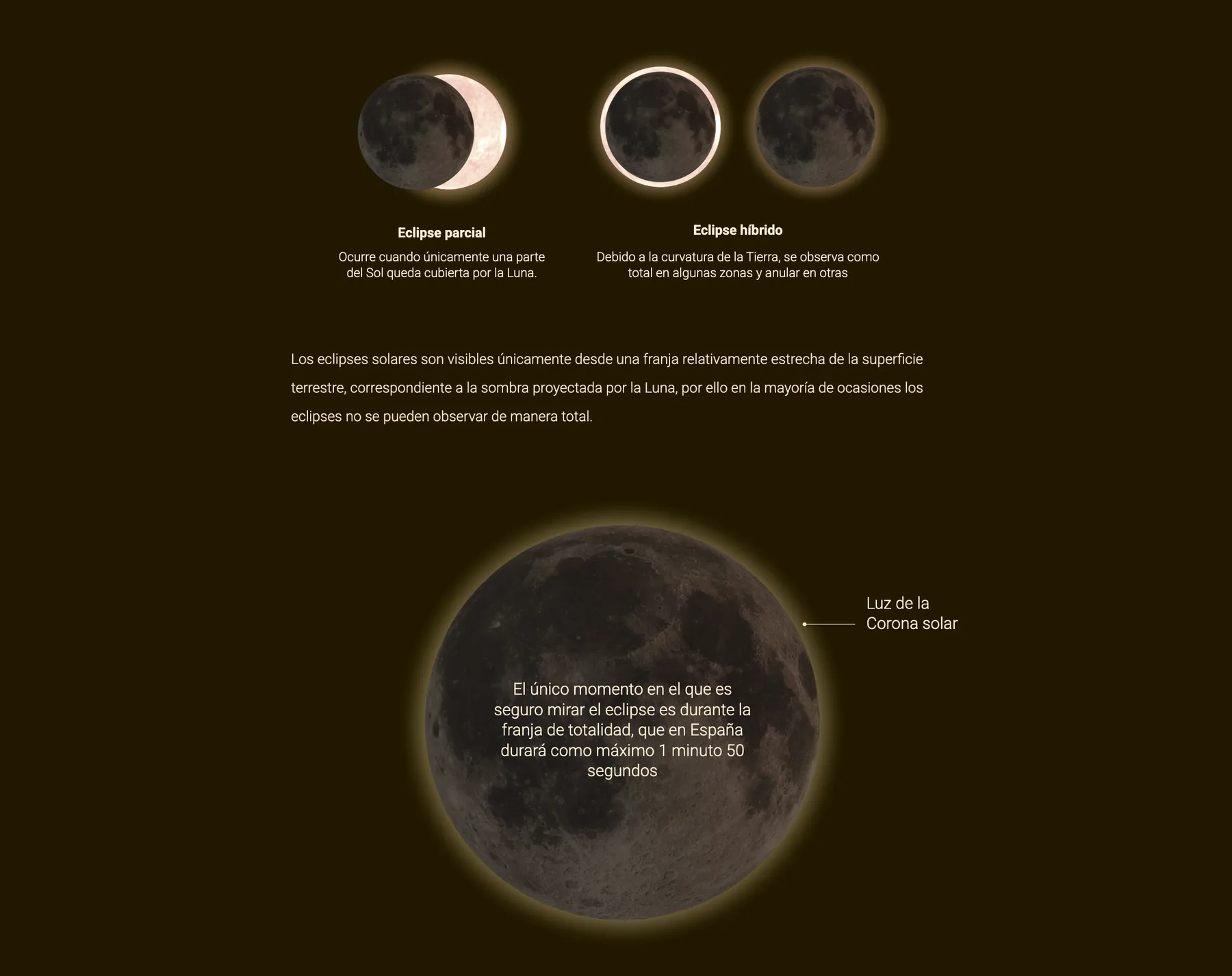
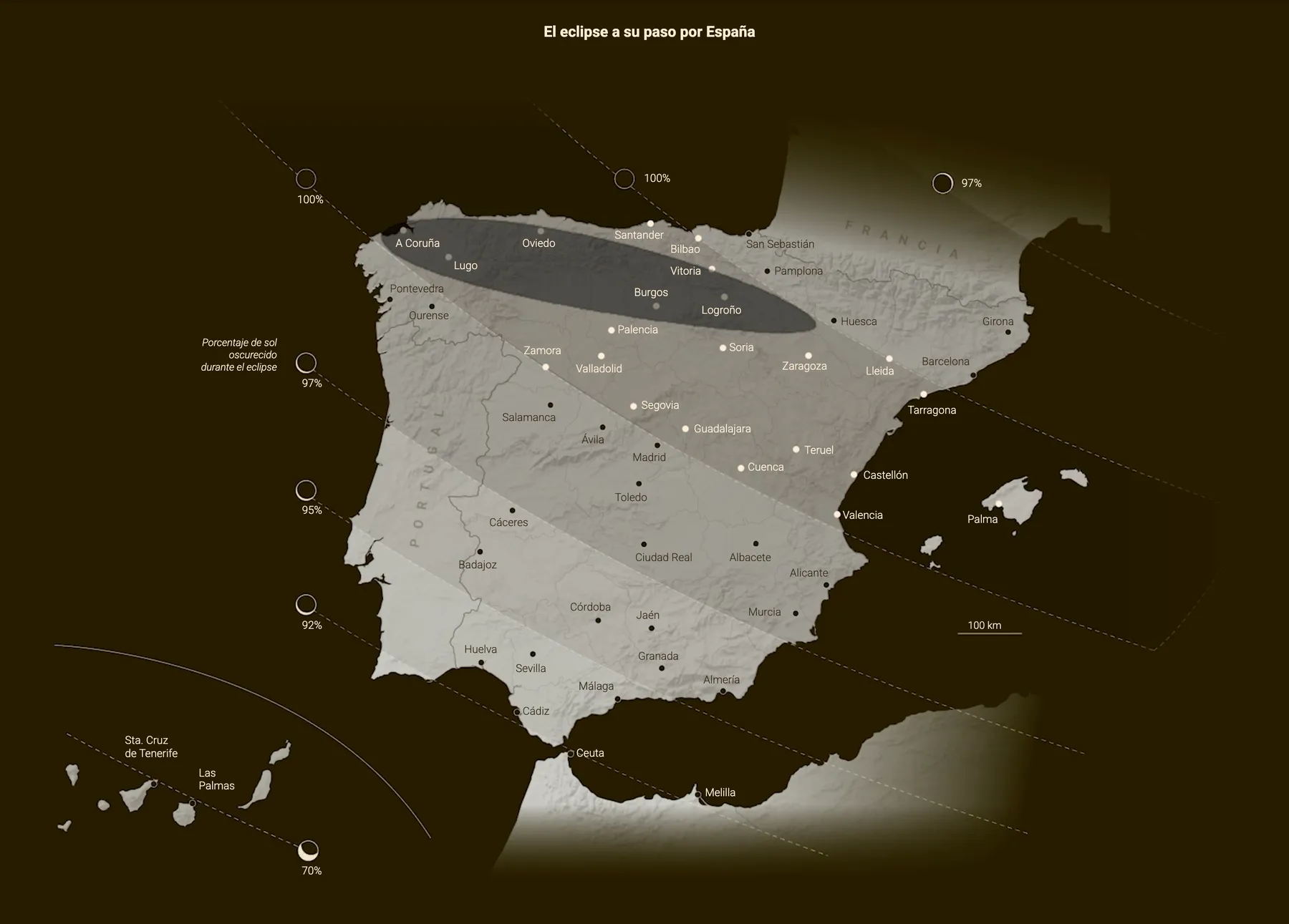
The Moon's orbit is tilted about 5 degrees relative to Earth's orbital plane. Only when the new Moon passes through one of the two nodes -- the points where both planes intersect -- does it align closely enough with the Sun and Earth to produce an eclipse.If the Moon passes through the node near its perigee (its closest point to Earth) it covers the solar disc completely: a total eclipse. If it passes near its apogee, it looks smaller than the Sun and leaves a visible ring of light: an annular eclipse.There's also the partial eclipse, when the Moon covers only part of the Sun, and the hybrid eclipse, which -- due to Earth's curvature -- appears total in some areas and annular in others. Eclipses are only visible from the narrow strip the Moon's shadow sweeps across.On August 12, 2026, the path of totality will cross northern Spain -- from Galicia to the Basque Country, with 100% of the sun darkened -- while the rest of the peninsula will see a partial eclipse of between 70% and 97%.